Tuesday, November 05, 2024

Thoughts on this day of days

November 5, 2024.

If I got any sleep last night - and as of this writing, there's no reason to believe I would have - I can guarantee that I woke up with a not-so-great feeling in the pit of my stomach.

November 5, 2024.

Will this be yet another day that will live in infamy?

Will this be - with the exceptions of the days on which people I loved died - the worst day of my life?

Maybe yes, maybe no.

My brother Rick, an experienced and astute observer of things political, told me a couple of weeks ago that he had a bad feeling about this one.

My friend Joe, an experienced and astute observer of things political, told me a couple of weeks ago that he thought Harris would win in a landslide.

Two men who have been directly involved in campaigns over the years. Two different gut feels.

Depending on the day, depending on the time of day, I'm a total downer, Rick-inspired (despired?) pessimist, or a grinning, buoyant Joe-inspired optimist. All I know is, over the past six months, I've gained about 10 pounds nerve eating. Why open the vino or mow down edibles when you can munch on Lindt dark chocolate with orange and almonds?

Even in Boston - which in 2020, broke about 85:15 in favor of Biden - I look at folks walking by with suspicion. Is that a MAGA?

If I lived in a red state, I'd likely have stroked out by now.

Whatever happens today (or over the next few days), if the outcome is not Joe's forecast landslide, I'll be wondering why.

But today's blog is not mostly, not directly about the election. It's about the disinformation/misinformation world we live in, where some folks seem to believe anything - however preposterous - they "hear" from certain sources, and act accordingly.

And so, it was a few weeks back, in the aftermath of Helene - or was it Milton? - that we heard that FEMA had to temporarily pull out of some communities in North Carolina because of threats of violence directed at FEMA workers.

And then there was this: a stunning headline in Rolling Stone that read "Meteorologists Get Death Threats as Hurricane Milton Conspiracy Theories Thrive."

Meteorolgist? That friendly guy on the evening news who tells you whether you need to bring an umbrella with you the next day? Or is it sunscreen? That guy?
"It's their job to warn residents about destructive storms—but political polarization has made them targets online."
"'People are just so far gone, it’s honestly making me lose all faith in humanity,' says Washington, DCM-based meteorologist Matthew Cappucci, in a phone interview conducted while he was traveling down to Florida for the storm. 'There’s so much bad information floating around out there that the good information has become obscured.' "Cappucci says that he’s noticed an enormous change on social media in the last 3 months: 'Seemingly overnight, ideas that once would have been ridiculed as very fringe, outlandish viewpoints are suddenly becoming mainstream & it’s making my job much more difficult."

The prime-crazy conspiracy theory: the hurricanes were created (using space lasers) or modified (and sent the way of red areas) by meterologists at the direction of Deep Staters - that would mostly be those enemies-of-the-people, the Democrats - to screw over red states. 

"'I put on armor every day to try to go online & make sure people aren’t saying things that could harm responses,' says [Meteorolist Katie] Nickolau. She’s had to fend off rumors that meteorologists should just use giant fans to blow the hurricane away or try nuking it. "'Stopping misinformation is becoming an exhausting part of the job which is taking away from spentime forecasting or sending out other info that could be helpful,' says Nickolau. She says her heart sinks when she sees a false post get millions of views 'cause it’s virtually impossible to go back & fact-check it for everyone that’s seen it. "After that call, Nickolau received an even more troubling message on her page: 'Stop the breathing of those that made them & their affiliates.' "'Murdering meteorologists won’t stop hurricanes,' she tweeted. 'I can’t believe I just had to type that.'"

Talk about shoot the messenger. Sheesh. 

Meteorologists, of course, aren't always right. How often have we packed the sunscreen when we should have packed the umbrella? How often have we made a last minute raid on the grocery store to stock up on milk and bread, knowing we really needed to be prepared for a major Nor'easter that's going to dump two feet of snow, but ends up fizzling into a yawn of a two-incher.

But do I blame Eric Fisher of WBZ-TV? No, no, a thousand time no!

Disinformation (deliberate lying). Misinformation (passing on someone else's deliberate lies out of ignorance). Willful and unwillful ignorance. Innate or acquired stupidity. Cynicism that says that nothing matters, the reality and government are boring, that everything is one big wrestling match, so why not root for the villain who entertains you and at least kinda/sorta says what you're thinkging. 

When I was a teenager, I started doing extensive reading on the Holocaust - first person accounts, historian analysis, fictional imaginings - and my fear since those long ago days has been that the biggest threat to democracy is not from the left, but from the right. From fascism. And while, even with a terrible outcome today, I don't foresee gas chambers, the wholesale wipe out of a people, I can definitely foresee people - hapless immigrants, political opponents - getting rounded up. Women being tracked to make sure they don't cross their state border to buy the morning after pill. The US abandoning historic alliances while cosying up to the Orbans and Erdogans. Journalists silenced. More books banned - and even burned. Armed to the teeth militias stoking fear and violence. Peaceful protestors met with an armed military. Gay marriage rescinded. Christian fatwas. Anyone not deemed sufficiently patriotic enough being hounded out of position, job, community. Using the military against "the enemy within" - which would be folks like Congressman - soon to be Senator - Adam Schiff, and anyone else who had the temerity to oppose him. ("Enemies" I've heard named by Trump's brigade of henchmen - men like Steve Bannon, Mike Flynn, Kash Patel, Stephen Miller - include Joe Biden, Hillary Clinton, Barack Obama, Mark Milley, and Anthony Fauci. Execution of such traitors has been bandied about.)

There's a reason I woke up today worried.

If I were the praying type, I'd be praying that Harris wins in a landslide, and that TFG concedes (gracefully would be a nice touch, but not one expected) and doesn't go all out urging the most die-hard and ignorant of his supporters to tear the country apart.

__________________________________________

And, no, I don't believe that everyone voting for Trump is an intellectually and morally challenged, fascism-welcoming person. But they sure do have a different world view than I do.  

Monday, November 04, 2024

I wouldn't bank on the outer banks

I'm a regular/irregular watcher of House Hunters, the HGTV show that follows a potential homebuyer on their house-buying journey. Supposedly. While the show purports to follow the homebuyer looking at three properties and picking one to have and to hold, what the show actually does is work off the house that someone has already made an offer on, and then backfill the plot with two other places - which may or may not have been houses that the purchaser actually considered. Fakery aside, the show is pretty interesting, as you get to see three properties and get a sense of what types of property are available where. (As in Atlanta suburbs: big and boring. As
in the city of Chicago: quirky and interesting.)

Recently, there was an episode in which a woman on the verge of retirement wanted to move from the DC suburbs to the Outer Banks of North Carolina, where she had vacationed over the years.

I've never been to the Outer Banks, but those islands are supposed to be gorgeous. 

There's just one problem: the Outer Banks are barrier islands that are made up entirely of sand. And they're eroding. And the houses that were built upon the sand are falling into the drink. 

Earlier this fall, over the course of just a few days, three houses went slip sliding away. 

On Hatteras Island:
..."every year, 10 to 15 feet of that white sandy beach is gone,” [superintendent of the Cape Hatteras National Seashore David] Hallac said. “And then the dunes and then the back-dune area. And then all of a sudden, the foreshore, that area between low water and high water, is right up next to somebody’s backyard. And then the erosion continues.”
Ocean waves eventually lap at the wooden pilings that hold up the beach houses. The supports could be 15 feet deep. But the surf slowly takes away the sand that is packed around them.

“It’s like a toothpick in wet sand or even a beach umbrella,” Hallac said. “The deeper you put it, the more likely it is to stand up straight and resist leaning over. But if you only put it down a few inches, it doesn’t take much wind for that umbrella to start leaning. And it starts to tip over.” (Source: WMTW)

The problem is not North Carolina's alone. Massachusetts' Nantucket is also built on the shaky foundation of sand. And every year, we get to see a story or two about an oceanfront house that used to be located about 100 feet from the water being swept out to sea. (Martha's Vineyward is luckier: a combo of rock and sand. Luckier still, the Maine islands that are built on rock.)

The Outer Banks islands are notable because their erosion is moving faster than fast. The Outer Banks are pretty much at sea level; Nantucket isn't exactly mile high, but its average elevation is around 30 feet. When it comes to warding off erosion, bigger's a bit better. When there's a hurricane heading their way, the Outer Banks islands are evacuated, and the miles-long traffic jams full of escapees trying to get across the bridge always make the national news. Nantucketers weather a storm on island. 

Anyway, what surprised me on that recent House Hunters I watched was that the Outer Banks disappearing act never came into consideration. Instead, most of the attention being paid was being paid to how close to the water she could get. 

In truth, the NC barrier islands are skinny, and if you're willing to walk a few miles, most of the houses are walking distance to the water. But the lure of actual waterfront is so great...

It's just that, do people not get what is happening?
“Perhaps it was more well understood in the past that the barrier island was dynamic, that it was moving,” Hallac said. “And if you built something on the beachfront it may not be there forever or it may need to be moved.”

Ah, the past, when some things were "more well understood."  

The House Hunters house hunter decided that having a bit more square footage was more important than living la vida beachfront. But I don't imagine she's going to have a very relaxing retirement. The Outer Banks could end up being the Under Banks, that retirement dream home part of a latter day Atlantis. 

Sigh...

Thursday, October 31, 2024

Happy Halloween, 2024!

Last Halloween, I was in Ireland, celebrating my niece's Master's Degree and, since it was Ireland, and they pretty much invented it, Halloween. Which I wrote about in Have yourself a merry little Samhain.

In 2022, I strolled around my neighborhood, which puts on a pretty good Halloween for itself, and took a bunch of pics of local decor. 

Beacon Hill usually goes all out, but when I did my initial walk-around/look-see a few weeks ago, there wasn't all that much to look-see. This was the absolute drabbiest drab display, but most of the ones I saw weren't up to par. (Other than the witches' legs, which are back at the Whitney Hotel.) Guess I was way early to check things out. I'll be out later today, and I'm hoping there'll be plenty of good displays to see.

My 2019 post was devoted to Halloween candy - and to St. Francis House - the day shelter where I will be spending the day. And, as has become my custom over the years, I'll have plenty of candy for the guests who come through the Resource Center - folks for whom life has provided a lot more tricks than treats.

Thinking about Halloween candy reminds me that I haven't yet had any candy corn or "harvest cream" pumpkins this year. On my walkabout, I'll have to swing by a CVS and remedy that. Can't have Halloween without the sweet goodness of candy corn.

In 2014, I posted about my first Halloween post-death of my husband. Halloween was Jim's favorite holiday - the only one he enjoyed celebrating. So I had a Snickers and some Good 'n Plenty in his honor.

My first Halloween post, way back in 2007, was on The Halloween Biz. And the biz has only gotten bigger since then.

Anyway, I've always enjoyed Halloween, and I suspect that - even though my stomach's in knots over the election on Tuesday - this year will be no different. 

In case you're wondering, I'm going out as myself. 

Happy Halloween!

Wednesday, October 30, 2024

Joro spiders? There goes the neighborhood.

Wildlife. In Boston.

There have always been rats, of course. And there are also mice. And racoons. And pigeons. And other birds, like starlings, robins, bluejays, and even hawks. And ducklings. Nuisance-wise, we have Canada geese and wild turkeys. Someitmes there are coyotes. Insect-wise, if you're unlucky, there are cockroaches. And if you're really unlucky, bedbugs. And there are ants, yellow jackets, mosquitoes. And silverfish, and daddy-longlegs, and itsy bitsy spiders. 

And now we have Joro spiders to worry about? 

We're not talking about "somewhere in New England, " here. Or "somewhere in Massachusetts." Or even "somewhere in Greater Boston." We're talking about Beacon Hill. On Mount Vernon. Right around the corner from where I live. 

Sure, tell me all you want that they're harmless, but Joro spiders a two-minute walk away? That's way, way, way too close for comfort.

Photographer Joe Schifferdecker was the first to spot and document this invader:

“It’s pretty cool that it’s in the middle of Boston,” he said. “It hasn’t been sighted at all in Massachusetts.” (Source: Boston Globe)
I beg to differ: no bright-yellow spider with a 1.5 inch body and a wing span of up to 5" is "pretty cool," unless it's behind glass in an insectarium. If it's in my home, or staring through a window (like the creepy luna moth staring at us through the screened window of a NH AirBNB a couple of years ago), or one my front steps, it's scary and creepy. 

This is the furthest north a Joro has been sighted. Last year, they only made it as far as Baltimore. This year, they were last seen outside of Philadelphia. (In case you're wondering, Joros are an invasive species, native to Asia, and first arrived about 10 years ago, most likely via shipping containers. Hope we're enjoying all those iPhones and Trump Bibles!)

Sure, they're interesting looking. And I guess I'll take the scientists' word that they're not harmful. 

David Nelsen is a biology professor from Tennessee, and his words are somewhat assuring.

“They’re not dangerous because the[ir] venom is really, really insect-specific, and we’re not insects.”
And a bite is no big deal, at least according to David Coyle, a Clemson professor of "forest health and invasive speciies."

...for a person, a bite from a Joro spider would be similar to a mosquito bite, causing some itchiness, redness, and swelling, he said. “Whereas something like a black widow or brown recluse, you get bit by one of those, you need to see a physician because that is a very different venom.”

But, but, but, if I encountered a Joro I'd still be freaked.

It's not exactly the size of a silverfish or a drain fly, or an itsy bitsy little brown house spider you can just crush with a piece of Kleenex and flush down the toilet. What are you supposed to do if you have a close encounter in your home? Yuck!

Joro spiders just around the corner? There goes the neighborhood.

Tuesday, October 29, 2024

As the baseball season winds down...

I never owned a baseball glove, but as a kid I did play baseball on occasion. I grew up in a kid-filled neighborhood, but most of the families on our street were boy-majority. With a 3-2 ratio, we were girl majority, and there were a couple of tied up families, but in the majority of houses, boys outnumbered girlss: 2-1, 7-0, 3-2, 4-1, 6-1. So if I wanted to play when my girlfriends weren't around for jumprope or jacks, it was "boy games." Thus, I played plenty of war, and plenty of baseball.

I never owned my own glove. I used my brother Tom's or that of one of the other boys. 

But I remember the thrill of a new glove, the TLC. 

I remember Tom, my even younger brother Rick, and the neighborhood boys, doing all sorts of things to break in their new Rawlings, or keep their old Wilson supple.

Wrap glove around a baseball and secure the glove around the ball with rubber bands, creating a better pocket. Sit on the couch watching a game, hand in glove, repeatedly whacking the pocket with your fist, perhaps in hopes or dreams that a ball would somehow sail through the TV screen and you'd make a brilliant catch. Oil glove with 3 in One Household oil to keep it from drying out. Because we'd all been in our grandmothers' back hall closets and seen those shirveled up gloves our fathers had played with. 

Ah, baseball. There's nothing like it, and all these many years after I first, as a two-year-old, uncomprehendingly "watched" a game on our b&w Philco, toddling over to the screen at my father's direction to pick a runner off base, I have loved watching this game (and, back in the day, even playing it a little).

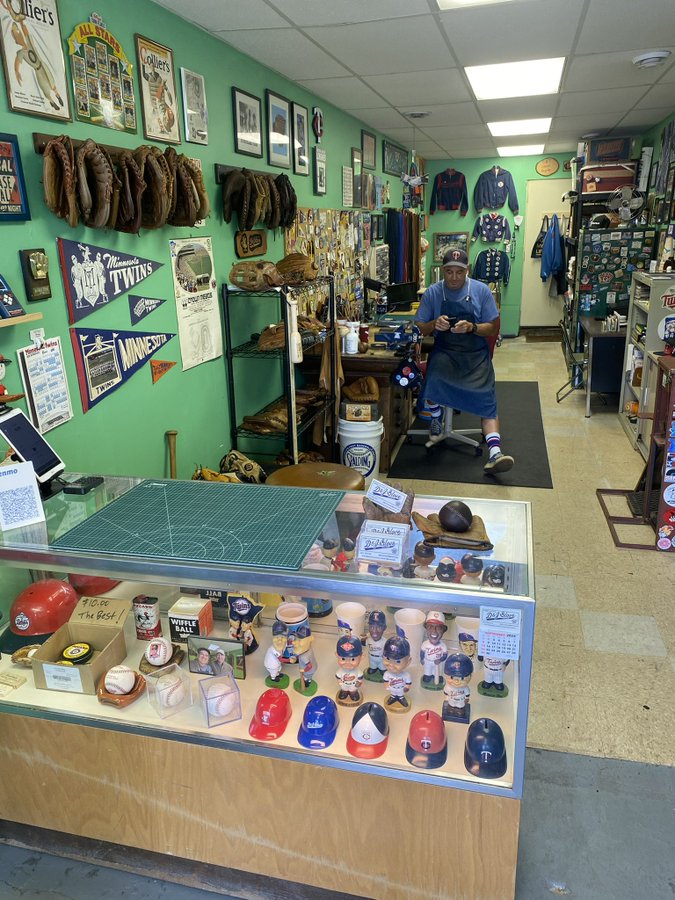
So I was delighted to see a mention on Twitter a while back that led me to an article on Jimmy Lonetti, a retired Minneapolis mailman who makes a living repairing baseball gloves 

Lonetti never expected his retirement hobby to grow into a brick-and-mortar business in the Longfellow neighborhood. He took care of his son’s Little League glove so he didn’t have to keep buying new ones, and teammates began asking for tune-ups on their own gloves, which continued as his son traded the Little League field for the diamond at his high school and later at St. Mary’s University.

His circle of clients grew along with his son, eventually leading to the birth of D&J Glove Repair in 2010 with the help of a friend in advertising and an eighth-grader who set up the website. (Source: Twin Cities Business)

And now Lonetti is running what may be the only baseball glove repair shop in existence - where, among other things, he hosts Twins watch parties - where folks (and his repair jobs come from around the country) bring their gloves because they'll find a level of expertise they won't find in, say, a shoe repair shop that sidelines in glove repair.

Posted in Lonetti's shop is a vintage ad/sign, dating from the 1950's, when I first fell in love with the game. 

“A baseball glove is a beginning and an ending, a boy’s first sure step toward manhood, a man’s final lingering hold on youth. It is a promise, a memory,” the sign reads. “A baseball glove is a dusty badge of belonging, the tanned and oiled mortar of team and camaraderie. In its creases and scuffs slots sunburned afternoons speckled with thrills … 1,001 names and moments strung like white and crimson banners in the vast stadium of memory.”

Corny? Yep!  But cornball, history, nostalgia have long been part of this venerable game.

And there's Jimmy Lonetti, with a last name worthy of the Golden Age of Baseball, when team rosters were peppered with Italian names like "Poosh 'em up" Tony Lazzeri, Joe and Dom DiMaggio, Scooter Rizzuto, Yogi Berra, Joe Garagiola,  Rocky Colavito, Tito Francona...

As the baseball season winds down, here's wishing Jimmy Lonetti and his shop an successuful Hot Stove League season, with all sorts of gloves in terms of a bit of professional TLC pouring into his shop. 

Image

Monday, October 28, 2024

Sarco? I think not.

The older I get, the more my thoughts turn to mortality in general, and my personal mortality in particular.

I'll "only" closing in on 75, so I certainly hope that the end game is not nigh. Still, sooner or later it happens to the best of us. 

Like everyone else in the world who thinks about their own death, I hope that when the time comes, I check out quickly and painlessly. My father died at 58 after a seven year battle with kidney disease. His death was neither quick nor painless. My mother, age 81, had two miserable weeks in the ICU before she died of heart disease, but I'd take those two miserable weeks of wind-down vs. the long goodbye slog. But as long as I'm healthy and with it - as my mother was: when she died, she was still volunteering, still taking courses, and had three trips planned -  I'd sure like more than 81 years, even though when my mother died it seemed pretty old to me.

My Aunt Mary (my mother's sister) made it well into her 90's, and up until her early 90's she was independent and vigorous. If you saw or spoke with her, you'd think you were with someone a decade - maybe even two decades - younger. And then she wasn't so independent and vigorous, but still doing more or less okay. And then, sadly, for the last long months of her long life Mary was bedridden, crying, praying to die. This from a woman who was so strong, tough as nails, not one scintilla of self-pity running through her veins. Sigh. 

My Aunt Margaret (my father's sister) didn't make it to Aunt Mary's great old age. She died at 85, but it was quick and, as far as we know, painless. And Peg died with her boots on. The evening before her death, she'd hosted members of her family for dinner, including a new great-grandchild. On the day of her death, she went to Mass, went to the Star Market, went to the library. And came home, took a nap, and died on the same daybed my grandmother had died on seventeen years before, under the same yellow-and-brown afghan (crocheted by my mother) that Nanny had died under. 

We all want a Peg death, that's for sure. Maybe a Mary death, with the trade off of suffering through a final bad spell in exchange for a decade more of good enough years. Maybe even a Nanny death, although she had tremendous mobility issues for years and her final years were pretty constrained. (Of course, I don't have a daughter to take me in and take care of me for the final half-decade of my life.)

My husband died too young - at 70 - and his last couple of years were on the cancer rollercoaster, with periods of misery interspersed with periods of mostly okay. Not a great way to go. But Jim approached his death with equanimity and good humor, and, in the end, refused a last chance to prolong his life for a few months (a few months of mostly chemo suffering). While I hope for a Peg death, if I get a Jim death, I hope I go out with the same equanimity, good humor, and practical wisdom.

During Jim's final months, we did vaguely explore a move to Vermont, a right-to-die state. More than once, Jim told me that even if he wanted out, he would never ask me to give him morphine - which we had (but never used) throughout his time in home hostice - because he wouldn't want me to get in any trouble. So, we looked a bit at Vermont, where Jim was born and grew up, but nothing came of it. 

I'm a believer in right-to-die, and have voted in favor of it when it's been a ballot initiative. Not that I'm a 100% believer. What I do believe is that there need to be slippery slope safeguards in place so that it doesn't turn in to a convenient way to get rid of folks who are no longer quite as convenient as once they were.

But if I'm actively dying and miserable, in hospice, nearing the end, please hold off on the intubation, the invasive problem fixing, the forced feeding. Just up the morphine dose, keep me out of pain, and let me drift off into the oblivion of The Big Sleep.

Would I be more pro-active in terms of a planned exit, as in our non-transfer to the great state of Vermont for Jim? I doubt it. I've always been more of a let's just see what happens kind of guy.

My end-of-life meditations pretty much presume I'm compos mentis. So far, I avoid going down the path of thinking about what to do if I get Alzheimer's - other than the stray is this it? thoughts that intrude when I can't remember the word for poncho, or when I leave my keys on the kitchen counter rather than on the credenza.  

Anyway, there's apparently another end-of-life option on the horizon, the Sarco death capsule, which was recently tried out in Switzerland.  

The “Sarco” capsule, which has never been used before, is designed to allow the person sitting in a reclining seat inside to push a button that injects nitrogen gas into the sealed chamber. The person is then supposed to fall asleep and die by suffocation in a few minutes. (Source: The Boston Globe)

Several people were detained by the police on "suspicion of incitement and accessory to suicide" after a 64 year-old American woman checked into the Sarco, a 3D-printed device developed by Exit International, a Dutch assisted suicide group. 

Switzerland is a logical place to beta-test the Sarco.

Swiss law allows assisted suicide so long as the person takes his or her life with no “external assistance” and those who help the person die do not do so for “any self-serving motive,” according to a government website.
Unlike some other countries, including the Netherlands, Switzerland does not allow euthanasia, which involves health care practitioners killing patients with a lethal injection at their request and in specific circumstances.

Switzerland is among the only countries in the world where foreigners can travel to legally end their lives, and is home to a number of organizations that are dedicated to helping people kill themselves.

Despite Switzerland's generally positive attitude towards right-to-die, and the country's becoming a destination for suicide tourism, there are some who take issue with the Sarco, questioning its legality in terms of product safety and use of nitrogen. 

The product safety concern is interesting. Is the Sarco safe if it safely kills someone? Unsafe if the person takes too long to die?

I don't know about you, but the Sarco is not how I want to "slip the surly bonds of earth." I want to die in a comfy bed or relaxer chair, not in a 3-D printed device that looks like it belongs in a modernized, souped up version of an amusement park Bump'em Car ride. Or on the bobsled course in the Olympics.

Still, it's something worth thinking about. 

What's the right way to go????

Thursday, October 24, 2024

Dumb just keeps getting dumber

When I first heard about the raw-dogging on airplanes trend, my first thought, quite naturally, was ewwww. The very idea of joining the mile-high club was disgusting enough. Who wants to have sex in a cramped and none-too-clean airplane toilet, especially when everyone on the plane knows what you're up to? Did we really need the additional bit about rawdogging (i.e., going at it without using a condom)?

Turns out my definition of raw-dogging just wasn't up to date.

Turns out, it's become something of a Swiss Army knife term "used for anything being done wihtout protection or support."

And one of the most trendy of the raw-dogging activities is (mostly) young men spending time on long-haul flights "without any in-flight entertainment, films, books or music." 

“Just raw-dogged it, 15 hour flight to Melbourne," boasts Australian music producer Torren Foot on TikTok, blinking hard as if to stay awake.
"No music, no movies, just flight map."

Some also avoid eating or drinking. A few say they won’t get up at all, even to use the toilet. (Source: BBC)

Well, I've never been on a 15 hour flight. I think 8-9 is my max. And I've certainly done long haul flights without music or video. But I do need something to read. I do like the flight map - so Zen. And there's no way I'm on a flight that's much more than an hour or two without downing some water AND making a trip to the cramped, none-too-clean toilet.  

But sitting through a long flight, just staring ahead, has become some sort of finding-my-alpha-male-crucible for men looking for a tough challenge. 

One fellow who stepped up (sat down?) to meet the challenge was a Man City footballer named Earling Halland, who:
...recently joined the trend, posting that he had got through a seven-hour flight with “no phone, no sleep, no water, no food” and had found it "easy".
Is it just me, or does Earling Halland - who's in the picture there - look like an AI? Just saying. 

Anyway, it's become a thing, and things with respect to in-flight raw-dogging have quite naturally made  their way to TikToks of "mostly athletic-looking young men"
....staring at the in-flight map or the safety instructions card, vowing to use the “power of the mind” to get them through.

Seems like it may not be the healthiest thing in the world to do.  

“They’re idiots,” says Dr Gill Jenkins, a GP who also works as a medical escort in air ambulance work. “A digital detox might do you some good, but all the rest of it is against medical advice," she says.

"The whole thing about the risk of long-haul flying is that you’re at risk of dehydration.

"If you’re not moving you’re at risk of deep vein thrombosis, which is compounded by dehydration. Not going to the toilet, that’s a bit stupid. If you need the loo, you need the loo."

Others take a kinder, gentler view, opining that it's good to take a break from always on, to take the opportunity to just sit there and think. Or stare at the flight map. 

Business psychologist Danielle Haig believes the raw-dogging trend provides:

"...an opportunity to recharge mentally, gain new perspectives,” she says.

She thinks the trend signifies “a collective yearning for balance as people seek to reclaim their mental space and foster a deeper connection with their inner selves”.

And she reckons that raw-dogging allows young men, in particular, the chance to showcase their ability to handle solitude and discomfort with stoicism.

One thing to do without videos, music, or a good (or even a bad) book for 10-15 hours, but you have to be nuts to put your life at risk by not staying hydrated and setting yourself up for deep vein thrombosis. 

That's just dumb. 

But, alas, dumb just seems to keep getting dumber all the time. 

Wednesday, October 23, 2024

Who's that again in the next cubicle?

I'm all in favor of work from home (WFH), with an ultra-strong preference for a hybrid model - either 3 days in, 2 days WFH, or 2 WFH, 3 days in the office. A hybrid model gives employees some breathing room: no commute, throw a load of wash in, catch up with the kiddos after school and catch up on the work after the kiddos are down for the night. And having time in the office also gives employees the opportunity to get to know their colleagues, to have impromptu meetings where problems are solved and ideas brainstormed, to read the room in a way you just plain can't on Zoom, to have genuine human contact in an increasingly isolated world. Time in the office also makes it a lot easier to onboard new employees. 

So Hybrid WFH, yay! Best of both worlds. BIG YAY!

The downside of full WFH is, of course, the opposite of the above. 

And, apparently, the empty offices that accompany WFH may be a matter of life and death.

As happened in August when a Wells Fargo employee had  "scanned into her office on a Friday morning and was found dead at her desk four days later."

According to local outlets, authorities said 60-year-old Denise Prudhomme entered her Wells Fargo office building located on the 1100 block of West Washington Street in Tempe, Arizona, at 7am on 16 August. (Source: The Guardian)

Prudhomme's body was discovered when a fellow employee who was just strolling around the building noticed something amiss in her cubicle, which was in a somewhat isolated space off the main aisle. Other employees had smelled a noxious odor, but chalked it up to bad plumbing. Oh.

Obviously, this can't all be laid at the door of WFH. 

Sure, Prudhomme was in the office on a Friday, a day on which many WFH-ers WFH. And her body wasn't found until the end of the workday on Monday, another popular WFH day. But maybe her job was one in which she didn't interact regularly with others, virtually or in person. Or maybe she died late in the workday on that Friday, after her virtual meetings were over. And who was going to discover her body over the weekend? I'm guessing that one thing that WFH has done is radically decrease the amount of time folks spend coming into the office on weekends. 

And it looks like she may have lived alone, given that no one reported her missing. Even my often-oblivious husband would have noticed if I didn't make it home from work on a Friday evening. So, if she lived at home and didn't have any plans for the weekend - which I entirely get: when I worked full time, I had plenty of weekends where I craved my "white space"; introverts be like that - no one would have noticed that she wasn't around

Still, hard not to believe that, in a full(er) office, someone would have passed by Denise Prudhomme's cubicle and noticed that something had gone terribly wrong. Maybe even saved her life. As of this writing, the cause of her death wasn't known. Foul play is not suspected. But maybe she choked on something, and someone in the next cubicle might have known the Heimlich maneuver. Maybe she had a heart attack, and could have been CPR'd back to life if someone nearby had heard her head hit the desk. 

People do die at work. When I worked at Wang Labs, we had layoffs all the time. And in the run up to one of the worst layoffs - in early Octobe one year, they'd announced that there'd be a major reduction by December 1st, and damned if they didn't wait until December 1st - a fellow who, as it turned out, was on the pink slip list, had a heart attack and died. 

But the people who worked in the cubes surrounding his knew what had happened. They just weren't able to save his life.

Anyway, hard not to read about Denise Prudhomme and think that, if there'd been more people around, she may not still be alive. But her final story wouldn't be worldwide, tsk tsk news. And fodder for bloggers. Sigh.

Tuesday, October 22, 2024

"The Temu version of a panda"

Who doesn't love a panda?

They're darling. They're fluffy. They're playful. They're cuddly. We can't get enough of them.

And as Americans, we truly can't get enough of them. There are a couple of new arrivals at the San Diego Zoo - on loan from China -  but the ones in the Atlanta Zoo will be repatriated back to China later this year. 

But we really can't complain. We're lucky to have any, given that there may be fewer than 2,000 giant pandas in the world, 800 of them in zoos or breeding centers. And even some Chinese zoos don't have any of these black and white cuties. 

One of the bereft zoos is Shanwei. Not to be outdone by the competition, the innovators at Shanwei decided to transform two Chow Chow dogs into real fake pandas. 

Like pandas, Chow Chows are native to China. But that's about where the resemblance ends. Chows are orange. They have blue tongues. Unlike pandas, which are mostly placid and sweet, Chows are considered aggressive, mean. And they're dogs; not pandas.

It was canny zoo patrons who figured out that the Shanwie pandas they'd paid to see were painted dogs. 

According to the New York Post, visitors at the Shanwei Zoo realized they were being bamboozled when the so-called pandas began panting and barking. Pandas are native to China and an international symbol of the country.

In one visitor’s video, one of the “pandas” was visibly panting while resting on a rock in a fence, while another clip had a panda with a long tail strolling about.

“It’s a PANdog,” one viewer wrote, while someone else joked: “That’s the Temu version of a panda.”

“They were panting that’s why they are pandas,” a third noted. (Source: The Independent)

The zoo has admitted to the ruse; some patrons want their money back.

Shanwei isn't the first Chinese Zoo that's engaged in panda fakery. 

In May, NBC Newsreported that Taizhou Zoo in Jiangsu Province had also painted Chow Chows. Zoo representatives initially claimed that the animals were a rare breed of “panda dogs,” before admitting that such animals don’t exist. At the time, zoo officials told Chinese state media they had advertised them as “panda dogs,” and did not intentionally mislead anyone.
Not that it's okay, but exhibiting "panda dogs" is definitely not as misleading as caling them pandas.  
When journalists asked them why they invented the idea of “panda dogs” to cover their tracks, a zoo representative explained, “There are no panda bears at the zoo, and we wanted to do this as a result.”
At least they were honest about it. But it's not just stupid and fraudulent to try to pass a dog off as a panda, or even a panda dog. It might be harmful. As one commenter noted on Weibo (Chinese Twitter). 
“Their fragile skin and naturally thick coats make them susceptible to skin diseases.”

Zoo officials countered that if it's okay for humans to dye their hair, it's okay for pandas.  Hmmmmm. 

Whether Chow-dying is harmful or not, there's no denying that pretending that a dog is a panda is about as stupid as it gets. What next? Paint some spots on a llama and label it a giraffe? Stripes on a horse and call it a zebra? Accept no substitutes! Let doggos be doggos!

Monday, October 21, 2024

Weird headline or what?

The Three Mile Island meltdown - which occuured in March of 1979, amazingly nearly 50 years ago now - was the worst commercial nuclear disaster in the US. And probably the third worst ever, worldwide, after Chernobyl (1986) and Fukushima (2011). In its aftermath, Unit 2 was permanently shuttered, its remnants carted away. Unit 1 survived until a few years ago, when it was closed down for financial (rather than safety) reasons. (The plant operated safely for decades post the Unit 1 meltdown.) 

But Unit 1 is slated to be reactivated, coming online in 2028 to provide power to Microsoft, which needs the juice to run its data centers - the ones that are gobbling up a tremendous - and tremendously increasing - amount of energy thanks to AI.

Microsoft will use this energy to support power grids in the mid-Atlantic states around Washington DC, a region considered an internet crossroads.

This area faces severe strain from data centers' massive energy consumption, raising concerns about grid stability as AI demands increase.

Tech giants like Microsoft, Amazon, and Google are rapidly expanding their data center capabilities to meet the AI revolution's computing and electricity needs. (Source: Raw Story)

I wouldn't want to live across the street from a nuclear facility, but I'm not opposed to nuclear energy. Even with the safety oncerns around nuclear, it doesn't produce carbon dioxiide or other greenhose gas emissions. Nor does its use result in air pollutants. Unlike fossil fuels. Most consider nuclear both cleaner and safer than the non-renewable energy sources: coal, oil, natural gas. So Microsoft (and other big energy consuming tech companies like Amazon and Google) want in on it. 

Bobby Hollis, Microsoft's vice president of energy, called the agreement "a major milestone in Microsoft's efforts to help decarbonize the grid in support of our commitment to become carbon negative."

If sun, wind, and water wheel aren't going to bring us enough sustainale energy, then bring on nuclear.

I'm more concerned with how much energy our reliance on tech demands. AI algos and models are insatiable. And, let's face it, a lot of what we use AI for is not exactly essential. No one needs a refrigerator that orders OJ when they're running low. No one needs AI-based searh to tell them what year The China Syndrome was released, when waiting a nano-second longer for regular search results will do you just fine. (Weirdly, coincidentally, The China Syndrome, a fictional account of a nuclear plant meltdown, was released in March 1979, twelve days before the Three Mile Island incident.)

Tech energy is, of course, invisible to us. Who thinks of how much energy our gaming, our searching, our shopping is using? Most of us our aware to some degree that our cars use energy. That our lights use energy. That our heat and AC aren't free. We pay the bills. We know we consume energy. But most of us give little or no thought to how much energy the tech giants are sucking up. Because we don't get the bill. Not directly, anyway. Sure, our smart appliances no doubt use more energy, but we sure aren't thinking about the AI memes the algos are churning out that we're retweeting.

Something to think about when we see the Microsofts of the world figuring out that they can resurrect a moribund nuclear facililty to keep them in business. 

Meanwhile, if they are going to use the reopened Three Mile Island, I hope that Constellation Energy, the facility's owner, comes up with a name change. (Maybe Microsoft AI can find a good one.)

Oh, and the weird headline or what? 

U.S. nuclear plant Three Mile Island to reopen to power Microsoft

What a world!

Thursday, October 17, 2024

Worst team-building ever

Offsites were one thing. A day away from the usual office whatever. So what if all anyone came away with was a slew of rolled up flipchart pages full of items that everyone was going to "execute" to turn the company around? It was still a day out. 

But the teambuilding events? Oh, no. 

Mostly, anyway. 

I didn't so much hate the ones where we took personality tests and walked away with tips on how to get along with our psycho-dynamic opposites. (INTJ, by the way.) But even these could gang a bit agley. At one company, we took a poor man's version of Myers-Briggs where we fell into Blue-Green-Red-Orange color groups. I was a Blue: corporate analytic nerds. All the sales guys were Reds, mostly Flaming Reds. At one point, the Flamers, who were hooting, screaming, and chanting in some weird impromptu bonding excercise, turned on us Blues and started hollering and gesturing about what pussies we were, and how they were thrilled they weren't Blue. (Fast forward, and I could understand how members of the press felt at MAGA rallies.)

There was another one where we all painted our own versions of a Van Gogh sunflower picture. That one was okay. It was actually very interesting to see who did what in terms of trying for exact replication vs. vague use of the same color palette.) 

But I didn't like the team building exercises where we had to write and perform a cheer, make a heliocopter out of Tinker Toys, sit back to back with a colleague and tell them something deeply personal about yourself. And the absolute worst: learn to build trust - hah -  by falling back into a colleague's arms. Ugh on ugh. That one I really despised. 

Team building has increasingly taken a philanthropic turn, with groups signing up to do something charitable or other. 

Like hike up a mountain to raise money for the entirely admirable José Andrés' World Central Kitchen, the outfit that shows up whenever and wherever there's a natural or manmade disaster.

Over the summer, a team from Beazley, an insurance firm, climbed Colorado's 14,230 foot Mt. Shavano. 

This was obviously a voluntary event, as 14,230 feet, while doable in a day, is a pretty strenuous hike. (The only mountain I've ever made it to the top of is Mt. Monadnock in NH, which is only a bit over 3,000 feet high. It only took a couple of hours, and that was plenty enough for me. I've climbed Mt. Washington, but only made it as far as Tuckerman's Ravine. And I've also climbed Mt. Katahdin in Maine, the most strenuous hike I've ever been on, but I don't remember whether we got to the top. We're talking over 50 years ago for all of these treks.)

Anyway, underwriter Steve Stephanides, age 46, was on his second Beazley charity hike, which the company has been holding for more than a decade.

As the team of 15 Beazley-ites neared the summit, Steve decided to take a breather. While he was breathing, his colleagues made it to the peak and started heading down. The 14 all made it to the bottom safely.  Steve forged on and got to the top after his colleagues had exited. On the way down, he realized that something was off.
[He] used his cellphone to pin-drop his location to his co-workers, who informed him that he was on the wrong route and instructed him to hike back up to the summit to get to the correct trail down, rescue officials said in a statement. "In his initial attempts to descend, he found himself in the steep boulder and scree field on the northeast slopes toward Shavano Lake," according to officials. 
Just before 4 p.m. local time on Friday, Stephanides sent another location pin-drop to his colleagues that he was near the correct trail. Shortly after that message, a strong storm passed through the area with freezing rain and high winds, rescue officials said in a statement. (Source: ABC News)

Nothing went right for Steve. He lost cellphone reception and took multiple spills - at least twenty falls. After the last one, he couldn't get up. 

Meanwhile, his safe and sound colleagues didn't report that Steve was missing until 9 p.m. "some eight-and-a-half hours after he started his descent, officials said." Eight-and-a-half hours, as it turns out, is roughly waht it takes most hikers to complete the round trip.

Rescue teams sprung into action and after Steve spent a chilly, wet, and solo night in a gully was found near a drainage ditch. He was carried down and taken to a hospital. 

Rescuers said Stephanides was "phenomenally lucky" that the weather cleared on Saturday and he regained enough cellphone service to call 911.

At least Steve was smart enough to finally call 911 and not those colleagues.  

We don't know the full story. Was Steve Stephanides a hiking pro, who waved off his colleagues when they offered to wait up for him? Was he a jerk that they wanted nothing to do with? Were they all from different locations, so weren't a team to begin with, just a bunch of individuals who had Beazley in common, but didn't really work together?  (Steve works in Florida...) 

Were they jerks to abandon their colleague? Shouldn't a cuople of them have stayed at the top to wait for him to arrive? Shouldn't someone have alerted the rescue squads when that storm passed through? And - in a pretty perplexing move - the colleagues, on their way down, had collected the trail markers they had set on the way up. Guess they didn't trust Steve to pick up after himself, and I'm sure one of the rules of the road is to not leave your trail markers behind. Still...

I suspect there'll be plenty of awkward moments if and when these colleagues run into each other. HR might want to intervene. These guys should use some team-building!

Wednesday, October 16, 2024

Oh, let's just privatize everything

The hospital closings, bankruptcy filing, and reeking greed and venality of its private-jet-flying/yacht-sailing/Fifth-Amendment-taking CEO - oh, and I forgot to mention the patient deaths attributed to repossessed life-saving equipment for failure to pay bills while the CEO was swanning around on his jets and yachts - of the private, profit-driven (no surprise!) Steward Health Care have been much in the news these days, thanks to a brilliant Boston Globe Spotlight series. 

But Steward is not, of course, alone. There are plenty of other examples of privatized hospitals providing a shoddy version of what should be a public good. Because profits.

And one of those is Acadia Healthcare, a chain of private psychiatric hospitals. Given the lack of and demand for mental health services, Acadia has been just humming along churning out the profits.
But a New York Times investigation found that some of that success was built on a disturbing practice: Acadia has lured patients into its facilities and held them against their will, even when detaining them was not medically necessary. (Source: NY Times)

What's been happening is that folks in need of routine care show up in the ER, or are brought in by a police officer, or come in on their own based on a recommendation "only to find themselves sent to Acadia facilities and locked in."

A social worker spent six days inside an Acadia hospital in Florida after she tried to get her bipolar medications adjusted. A woman who works at a children’s hospital was held for seven days after she showed up at an Acadia facility in Indiana looking for therapy. And after police officers raided an Acadia hospital in Georgia, 16 patients told investigators that they had been kept there “with no excuses or valid reason,” according to a police report.

Acadia held all of them under laws meant for people who pose an imminent threat to themselves or others. But none of the patients appeared to have met that legal standard, according to records and interviews.
You'll get no argument from me that there are times when a person experiencing a mental health crisis should be held whether they like it or not. A fellow in Boston was recently sent to a state psychiatric facility after he was arrested for chasing folks around downtown streets, flailing around with a machete. When the name of the fellow sent to Bridgewater was published, I wasn't surprised. I knew him from the homeless shelter where I'm a long time volunteer, and where this guy radiated mental health issues, including hostility and disconnection, that were apparent even to us lay people. I'm glad he's off the streets and hope he gets straightened out. And I hope that Bridgewater State holds him long enough to get him straightened out. Or at least stable enough that he won't be chasing folks around with a machete.

But at Acadia, they're holding patients longer than they need to be held, and in many cases the reasoning behind the hold is financial rather than medical. 
Acadia, which charges $2,200 a day for some patients, at times deploys an array of strategies to persuade insurers to cover longer stays, employees said. Acadia has exaggerated patients’ symptoms. It has tweaked medication dosages, then claimed patients needed to stay longer because of the adjustment. And it has argued that patients are not well enough to leave because they did not finish a meal.

Without a legal intervention, patients are kept under lock and key in an Acadia hospital "until their insurance runs out."

Doctors, nurses, hospital management, patients, their families - all have reported bad behavior on the part of Acadia. 

There's no doubt that plenty of the old time state-run or other public psychiatric facilities were snakepits, where nobody got much by way of care. I remember driving by Worcester State Hospital - idealized view above - and thinking about what a scary fortress it was. And there's no doubt that there are more and more people in need of mental health care. Still, as we've seen time and again when public services and non-profit entities are replaced with privatized, profit-making concerns, the focus quickly veers from the supposed market efficiencies the private sector brings to a laser focus on profit making at the cost of providing services. 

Insurance companies are not, of course, in the business of reimbursing providers for services the insurance cos. don't deem necessary. So Acadia had to make sure they were making a compelling case for keeping patients. 

To do that, Acadia needs to show that patients are unstable and require ongoing intensive care. Former Acadia executives and staff in 10 states said employees were coached to use certain buzzwords, like “combative,” in patients’ charts to make that case.

In 2022, for example, state inspectors criticized an Acadia hospital in Reading, Pa., for having instructed workers to avoid adjectives like “calm” and “compliant” in a patient’s chart. That same year, employees at Acadia hospitals in Ohio and Michigan complained to their state regulators that doctors had written false statements in patients’ medical charts to justify continuing their stays.

At an Acadia hospital in Missouri, three former nurses said, executives pressured them to label patients whose insurance was about to run out as uncooperative. Acadia employees then would argue to insurance companies that the patients weren’t ready to leave. Sometimes, the nurses said, they wrote patients up for not finishing a meal or skipping group therapy.

Once Acadia won more insurance days for patients, it often would not release them before their insurance ran out, according to dozens of former Acadia executives, psychiatrists and other staff members.

Capitalism has much to commend it - the potential for prosperity, opportunity, creativity, high quality products - but, man, does it come with a downside. And one of those downsides shows up big time when it comes to healthcare (and education and prisons and, and, and). God help you if you're in need of mental health care and end up in an Acadia profit-making hospital. Not finishing a lousy hospital meal - no doubt prepared using the cheapest means possible; gotta squeeze costs out, don't you know - can be enough to keep you in the stir? 

Sure, let's just privatize everything.

Tuesday, October 15, 2024

I couldn't have done this

When I was in college, I spent my summers waitressing. After college, but before "real life" clicked in, I waitressed for a couple of years to finance travel. Over the years, when frustrated by my "real life" career, I'd often joke that I could always go back to waitressing. But in "real life," I couldn't have. There was much I enjoyed about waiting on tables, but I don't think it would have aged very well. I wouldn't have wanted to be on my feet running around for ten hours. I wouldn't have wanted to come home every night with the smell of roast meat and fried fish in my hair. Sure, everyone has to put up with demanding customers, nasty bosses, and idiotic colleagues, but for me it was probably easier to deal with an idiotic, nasty VP of sales than it would have been to deal with an idiotic, nasty line cook. 

So although I sometimes still joke about waiting tables, I know that I couldn't have. The closest I come is working a lunch or breakfast shift dishing out food at "my" homeless shelter, which is more like being a lunch lady than it is like being a waitress. 

But not Elaine Gingras, a Worcester woman my age who's been working at the IHOP on Route 9 in Shrewsbury for 50 years. 


Over the course of her career, Gingras spent a number of years as the head waitress, but stepped down after a decade or so to leave the thankless managerial stuff, like scheduling, and back to what she loved doing: waiting on tables and mentoring newbies. 
Interacting with customers is what gives Gingras the most joy. For years, she has served individuals and families who are regulars at the IHOP, asking them about their day, where they are from, if they are traveling someplace and even helping them if they were working on a puzzle.

“Some of them have passed on,” Gingras said. “I see families come in with their kids in infancy, and now I see their kids with their kids. I’ve seen generations.” (Source: MassLive)
Mostly, Elaine waited on regular folks, but she did wait on Neil Diamond, who came in with a bodyguard. 
“He had bacon and eggs, toast and coffee,” she said. “Then he told me to be quiet about it.”

My only celebrity serve - other than local pols - was waiting on the members of Blood, Sweat and Tears while I was working at Durgin Park. I don't remember what they ate, but part of the tip was two tickets to their performance at Paul's Mall (the Boston club at the time). The seats were great - front row; the performance was okay.  

I don't know Elaine Gingras, but I bet within two minutes we'd figure out that there's only one or two degrees of separation between us. She trained as a teacher - early on, she waitressed while teaching - and I'm betting she went to Worcester State or Anna Maria. Which means I would have known plenty of girls in her class. In any case, she sounds like a very nice person, and I would have been delighted if I had learned that, at some point early on, our waitressing paths had crossed. Maybe they did. Maybe we worked together at Ted's Big Boy in Webster Square. Or maybe I waited on her. She had waitressing jobs prior to IHOP, so maybe between those gigs and her long tenure at IHOP, she waited on me way back in the day.

So congratulations, Elaine, on your Golden IHOP Anniversary. Fifty years a waitress? Much as I like to kid about it, I never could have done it. Good on ye, Elaine. What a Worcester girl!